Happy Black History Month, y'all! I know it's almost over, but that doesn't mean I can't check in.
It's been a hot minute since I've said anything on this blog. I bet you thought I forgot about you, huh?
Well, you'd be... a little correct.
The truth is, I've been busy.
Between trying to get a book published and working a full-time job, I regret to say that I've been neglecting my duties to tell you about what I've been watching. I'm sorry to leave you hanging, but life's been a little hectic recently. (If you wanted to know what I've been watching in the meantime, you can follow me on Letterboxd here.)
Now that I'm back, though, I feel the need to put you onto something I discovered a while ago.
Allow me to introduce: Marvel's Moon Girl and Devil Dinosaur!
Listen close, because I'm only gonna say this once: Marvel's Moon Girl and Devil Dinosaur is the Into the Spider-verse of cartoon TV shows. As in, this show is visually perfect, musically captivating, and dreadfully underrated.
This show SLAPS.
I cannot begin to tell you how much I love this show, but I can try. If' you're not watching it already, you're missing out.
Moon Girl and Devil Dinosaur follows a Black teenaged girl named Lunella Lafayette as she goes about her life in the Lower East Side of New York City. Only, she's an absolute genius. After experimenting one day, she accidentally opened a portal to another dimension, summoning a giant red T-Rex named Devil. Together, Lunella and her dinosaur fight crime as the eponymous "Moon Girl and Devil Dinosaur." They become the champions of the Lower East Side, taking back their power from anyone who tries to take it from them.
Similarly to Big Hero 6 that came before, long before it was animated, Moon Girl and Devil Dinosaur started out as a Marvel comic book. Making her way onto the scene in 2015 with her first issue, Lunella Lafayette was declared the smartest character in the Marvel universe (Yes, that means even smarter than Reed Richards, Tony Stark, Victor von Doom, and Bruce Banner!), and along with her pet dinosaur, she started kicking butt and taking names using her genius and his strength.
The Moon Girl and Devil Dinosaur comics ran from 2015-2019, and she has fought with everyone from the X-Men to Miles Morales's Spider-Man (BTW, thank you Sinclair, ilysm.) They share a lot of similarities with the Moon Girl I watched on TV, but they are definitely different.
Moon Girl and Devil Dinosaur Comic #1 (2022)
Marvel's Moon Girl and Devil Dinosaur (TV series)
For example, one of Moon Girl's powers in the comic books is that she is able to create a neural link with Devil Dinosaur in order to switch consciousnesses with him. (While this happens in the show, it is only for one episode and is explained away using a scientific device instead of an innate ability). Another thing to note is that the Moon Girl from the comics is significantly younger than the one on TV at only 9 years old. The Moon Girl on TV is 13 years old and attends middle school with her best friend, Casey.
The show was how I first became familiar with Moon Girl as a character, and so the show version of Moon Girl is what I will be conducting this review on. I haven't read many Moon Girl comic books yet, but if I get my hands on a few, I'd be interested to see how many more differences there are in the characters.
Devil and Lunella in her secret hideout in a hidden underground subway tunnel.
I could gush about this series all day, honestly. If I did, I would start with the fact that Lunella is a little Black girl who also happens to be a genius, which is not a character model I've seen depicted so lovingly since Susie Carmichael on Rugrats in the 90s (and she was a toddler).
I've talked about the lack of Black kids in cartoons before [see my review on Craig of the Creek, along with my review of the first season of The Proud Familyreboot (although side note- I did actually enjoy the second season of Louder and Prouder so much more than the first. Perhaps it just took a moment to find its footing)], but I appreciate so much that Lunella is an authentically Black girl who just happens to be a super genius. I love stories where we get to see complex, multi-faceted Black kids.
I also love that she's a superhero. There's so much to be said about the freedom of allowing a little black girl super-genius to partner up with a giant red dinosaur in the middle of LES NY. It invokes a sense of playfulness that a lot of Black characters don't really get in media, especially in cartoons. While I admire cartoons that can stick to the reality of the Black experience growing up, like The Proud Family and even Craig of the Creek (which leans into a child's concept of fantasy without fully embracing the fantastical), Moon Girl and Devil Dinosaur goes balls to the wall in an effort to give Black girls more freedom in cartoons.
Not only does Moon Girl fight aliens, but she also travels through dimensions, she has met universe bending omniscient super beings, AND she has a talking DINOSAUR for crying out loud!
A major reason why this show means so much to me hearkens back to a poem by Danez Smith called "Dinosaurs in the Hood."
Let’s make a movie calledDinosaurs in the Hood.
Jurassic Park meets Friday meets The Pursuit of Happyness.
There should be a scene where a little black boy is playing
with a toy dinosaur on the bus, then looks out the window
& sees the T. Rex, because there has to be a T. Rex. (Smith, par 1-5)
Moon Girl fills the hole that something like that “Dinosaurs in the Hood”would represent. Almost down to the T. Not only is there a T.Rex (because there has to be a T.Rex) but there is an element of whimsy and fantasy that mixes with Black reality that isn’t explored often enough in life, and even less often in animation.
Not since the days of Static Shock (which was honestly before my time) have Black kids had the chance to see a Black superhero be the main character of their own fantasy cartoon. Sure, Black kids were allowed to have auxiliary characters in other cartoons (Cyborg from Teen Titans and Storm from X-Men the Animated Series come to mind), but to be the lead superhero, and to be allowed to be fantastical and witty and fun and human… that’s the dream, baby.
To top it off, this superhero show deals with everything from racial discrimination in academic spaces, to gentrification, to lack of care given to communities of color. It's insane to me that there are entire episodes dedicated to the biases we hold of people with criminal records, and the politics of Black hair, and they're all treated with the amount of care and consideration required without talking down to the intended child audience!
That said, Moon Girl isn't just a show focused on social issues (even though they are present), but this show tackles the general anxieties children may have about growing up, such as cyberbullying, fitting in at school, finding dates for dances, and navigating relationships with family and friends. Lunella deals with awkward scenarios at sleepovers, fights with her best friend, and she even wants to get away from her annoying parents sometimes, just like any other teenager.
Moon Girl is the Black girl's equivalent of Spider-Man, and I say that in all seriousness.
Not to keep making the comparison, though, but on a character level, I feel like this show was perfectly casted, just like how Into the Spider-Verse was perfectly casted.
Diamond White (who I knew from X-Factor when she competed in 2012), voices and the titular Lunella Lafayette. Not only is Diamond a talented voice actress in her own right, but she also sings a lot of the songs for the show (including the opening theme: see below), and brings Moon Girl to life in a way no one else could. Not only does she embrace slang without sounding inauthentic, but she brings joy and life to Lunella that reminds me of what it was like to be a little Black kid. I love her version of Lunella so much.
But Diamond White isn’t the only iconic casting choice. In fact, the whole voice cast is absolutely stacked.
Some of the voice talent featured in the show includes Laurence Fishburne (who also produced the series) as The Beyonder, an omniscient super being from another dimension, Alfre Woodard as Mimi, Lunella’s grandmother, and Craig Robinson as Lunella’s school principal. If that wasn’t enough, in season two, there are even some more unexpected voice actors in the cast, like Xolo Maridueña from Cobra Kai making an appearance, along with Robin Thede from Black Lady Sketch Show, and Erika Ishii from Dimension 20 (iykyk).
BTS of Laurence Fishburne as The Beyonder, talking about Marvel’s Moon Girl and Devil Dinosaur
Aside from the voice talent, the characters themselves shine through the screen in every episode. As a character, I love that Lunella has a commitment to her family, but she also has a commitment to herself. She’s a genius who recognizes her flaws, but also learns how to overcome them with confidence and grace. She’s kind without being inauthentic, and she really cares about her community. Overall, she’s perfect- a 10/10 character.
The other characters in this show are fun, too, with Lunella’s grandma Mimi and her best friend Casey immediately coming to mind. Mimi is loving, smart and caring, always teaching Lunella about how to stay true to herself and maintain her confidence in dark times. She also has a big secret that she really hopes won’t get out (no spoilers!). Casey is Lunella’s best friend and the only person she reveals her secret identity to. She’s a social media savant and constantly acting as Moon Girl’s manager/ PR rep whenever they’re in public. (Something I actually admire about this show is that they don’t make Devil a talking dinosaur. He mostly just growls and occasionally communicates with a slight speech affectation, however most of his dialogue is through images in thought bubbles so the audience knows what he’s saying without him actually having to speak.)
As if the characters and the voice acting weren’t enough to lure me in, the music of this show just had to steal my heart. The music is definitely a major highlight of the series for me.
In the pilot episode of the show, Lunella's mom gives her an old tape player that she eventually tricks out into a multipurpose music player/ baddie tracker. During every major battle in the show, Moon Girl turns on her music to give her a soundtrack to fight to. Each song underscores the episode it's in perfectly, but especially in high-stakes battles. The sound design in this show is impeccable, and honestly the fight scenes have made me cry more than once just because they're underscored by the perfect music number. If there is a heavy thematic meaning to the battle, you better believe the song will come up again later on. I unironically have several songs from this show on multiple playlists on Spotify (My personal favorite is “My hair is a mood” by Jane Handcock; it’s the modern Black girl’s version of “I am not my hair” by India Arie. Again, iykyk).
To make my point as clear as possible, I'll just say that the composer for this show is Rafael Saddiq, who, if you didn't know, is a multi-hyphenate Grammy winner, and a producer on Beyonce's iconic Renaissance album, for which he earned two additional Grammy nominations. This man is serious about his business, and it shows.
Clearly, I know what I'm talking about, because as of February 2024, Marvel's Moon Girl and Devil Dinosaur has five Emmy wins. Those wins were for outstanding main title (see below), outstanding casting for an animated program (told you!!), and outstanding special class animated program for the pilot episode (among other awards). (If anything, this is proof that I should be an Emmy voter.)
Moon Girl is an Emmy winner, baby! Now that's what I'm talking about!
THE EMMY WINNING Moon Girl opening title theme.
Season two just premiered earlier this month, and I've already binged every available episode of the series to date. Suffice to say that the second season builds on the first in the best way possible, although I'd be lying if I didn't say that my favorite episode of the show is in season two. As an anxious perfectionist, season 2, episode 7 holds a special place in my heart (particularly as I dip my toes in the publishing industry- yeesh). You should watch season two for that episode alone, but the entire season is excellent television.
Poster for Marvel's Moon Girl and Devil Dinosaur Season Two
Lunella with her new science teacher, Dr. Ojo (from Wakanda), in Season 2, Episode 7: “Make It, Don’t Break It!” of Marvel's Moon Girl and Devil Dinosaur
I'll end this by saying if you haven't seen the show even after all this, you don't have to subscribe to Disney+ or just take my word for how good it is. You can see the show for yourself! The first six episodes of the show are on YouTube for free (along with the season one finale, so be careful of spoilers). You can watch it in this playlist, here.
I hope you love it as much as I do.
I know I did this review a little differently than I've done past reviews, but I've been away for a while, so things may be a little different around here while I settle back in. I just wanted to let you know that this show means a lot to me. I hope it means something to you, too.
This show is obviously S tier. I feel the same way about Marvel'sMoon Girl and Devil Dinosaur that white women felt about the Barbie movie last year. Moon Girl is everything to me, representing facets of Black girlhood that I wish were more widely talked about in animation, and allowing grown ass women like me to feel seen for the first time in a cartoon about a girl who owns a dinosaur. It is easily one of my favorite shows, and I think it is on par with the Spider-verse films in terms of quality, heart, and care presented to its Black characters.
To kick off the first real post of the new year, I wanted to bring your attention to something amazing I discovered recently: Craig of the Creek.
Craig of the Creek is my new favorite comfort show, and I want to share it with all of you now.
Now, I've been meaning to watch this show ever since my "Fight Night" post about The Proud Family and its reboot. In it, I mentioned that I was disappointed that The Proud Family was the only black cartoon to make a lasting impact on children's animation within the last 20 years. Since then, black cartoons have been far and few between, with even less of them for children/ family audiences. Much to my disappointment, out of all the children’s cartoons on TV recently, the only black show that I was aware of was Craig of the Creek.
A black animator I follow on YouTube, Toonrific Tariq, did a wonderful video on why this is a shame, and why this shouldn't be the case, specifically in the context of Craig of the Creek. I highly recommend watching the whole video, as it covers everything that I felt and still feel on the subject of black animation, all while being funny and relatable.
Toonrific Tariq's video, "How to Black: An Analysis of Black Cartoon Characters"
Nonetheless, I'm glad that Craig of the Creek exists in the capacity that it does today, and I'm so happy that I was able to watch all four seasons of it that are currently available on HBO Max.*
I want everyone to appreciate this show as much as I do, and so I'm going to talk about it at length until you get on my level.
Let's begin, shall we?
Category 1: Characters- A+
One area where Craig of the Creek shines where other shows (animated or otherwise) may fall flat is their characters.
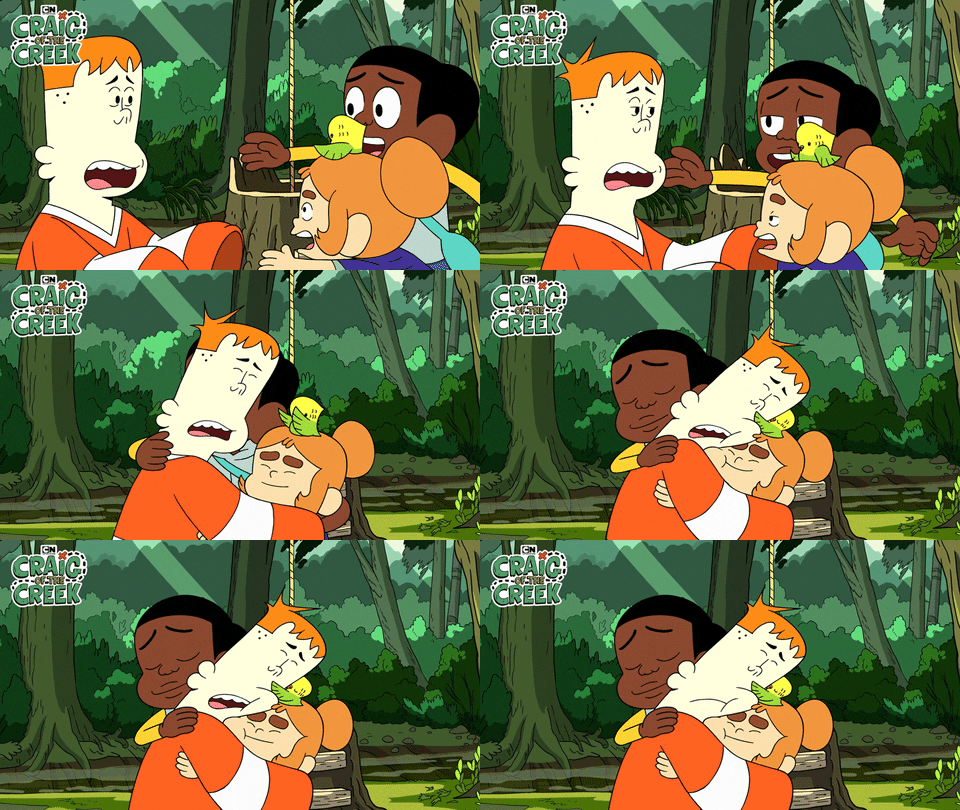
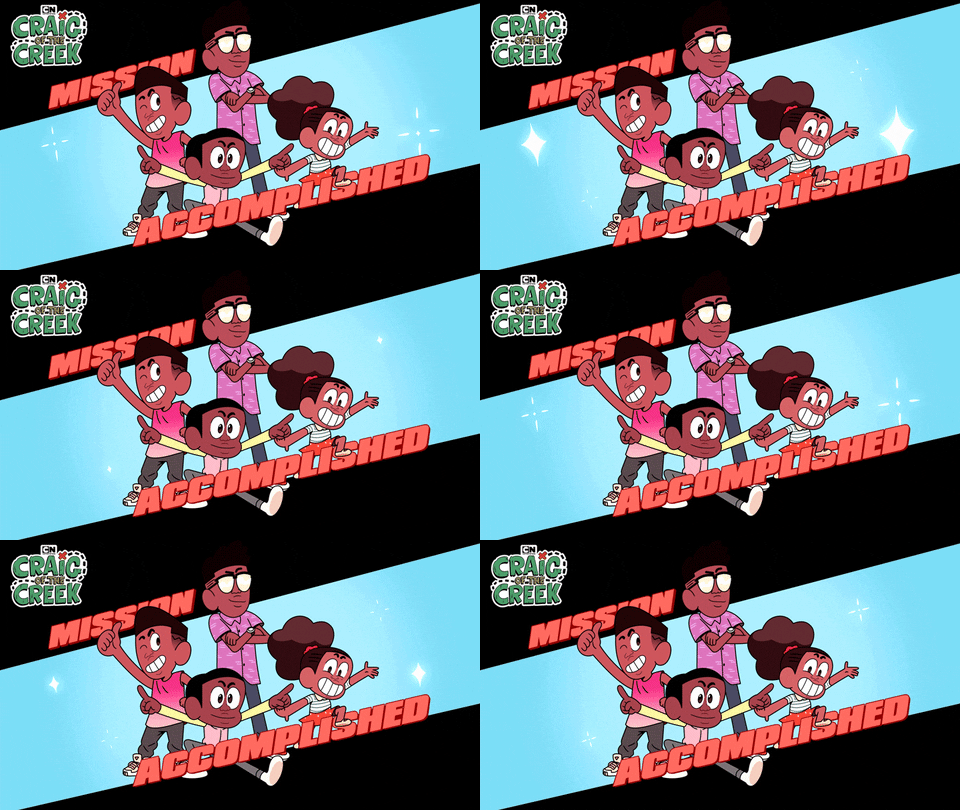
The three main characters of this show are the titular Craig Williams, along with his two best friends, Kelsey Pokoly, and John Paul "JP" Mercer. They each have their own unique character traits that make them stand out as people, but of course, they all work better as a team. It's crazy that none of these characters are older than twelve, but they all have a lot of personality between them.
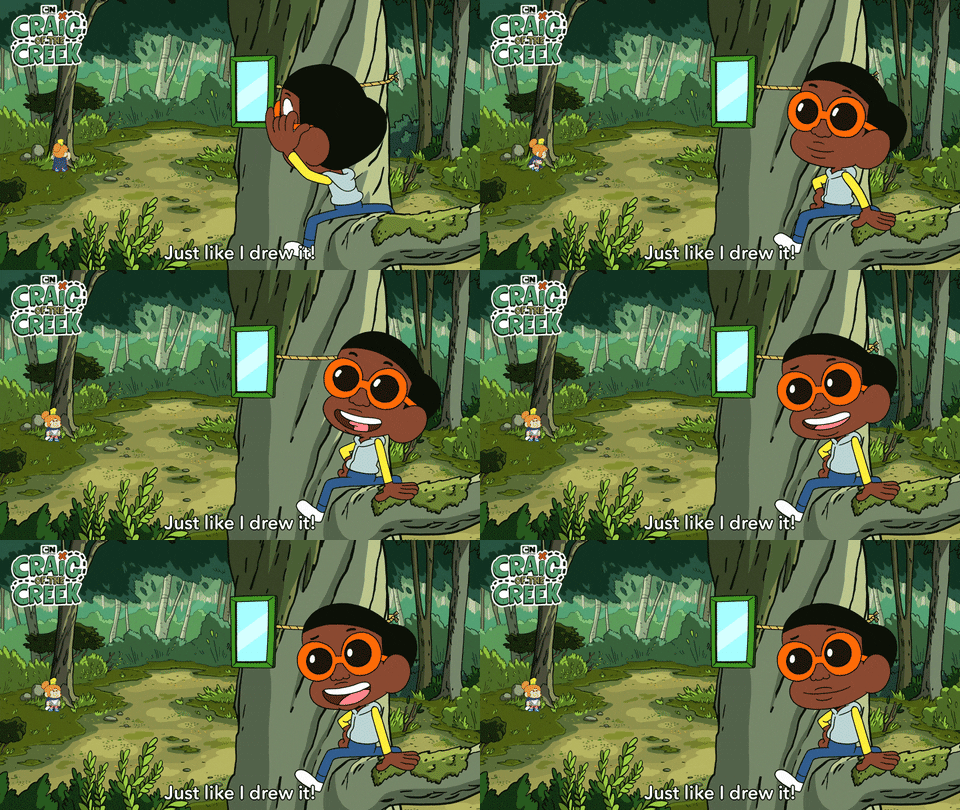
Craig is a map-maker, and uses his love of the Creek behind his house as an excuse to explore and document everything he's found in and around it. He helps the other kids in the community and he often likes to go an adventures just to discover what's out there. He's a smart kid, with an eye for math and engineering, but he's a little oblivious sometimes, which can get him into trouble.
Kelsey is a warrior at heart, who is determined to become the hero of her own fantasy novel series. She loves reading and writing fantastical stories about her and her friends, and she's definitely not afraid of a fight. She often hangs around the Creek with her pet bird, Mortimer, and her PVC pipe turned "sword" to fend off any enemies at the Creek.
JP is the heart of the group, and he's also the oldest among the three friends. He's never afraid to get messy in the Creek, and he's not the sharpest tool in the shed. Even though he may not be the brightest in his friend group, that doesn't make him dumb by any means- he has the highest emotional intelligence of everyone around him. He loves monster trucks and going on adventures with his best friends.
JP, Kelsey and Craig
While the main characters of the show are important, and it is good to root for them and like them, I think Craig of the Creek has more than enough side characters to also root for and like. In fact, the supporting characters may be the best part of the show.
In the series, we get to know Craig's entire family- his brother and sister, his cousins, his aunt and uncle, his grandparents. We also get to see all of the kids he hangs out with in the Creek every day after school. And let me tell you- there are a lot of them.
Left to right: Bryson (Craig's cousin), Craig, Bernard (Craig's older brother), and Jessica (Craig's younger sister)
Personally, I love Craig's younger sister Jessica! She's easily my favorite character. I also love Craig's older brother, Bernard! I love Kelsey's father! I love Craig's mom! I honestly think I love the side characters in this show more than I love the main characters, and that's saying something because the main characters are so lovable.
Some of my other favorite recurring characters are- Sparkle Cadet, Wildernessa, Cannon Ball, Omar (The Green Poncho), Toman (AKA T-Money, AKA the T-Man, AKA the Tomato-Master), The Elders of the Creek (Mark, David, and Barry), Kit, and Bobby. (There are definitely more, but I had to have a hard stop for this list otherwise I would just list everyone in the Creek.)
Surprisingly, I also love some of the one-off characters. I love Paloma, the Jinx-girl. I love Angel, the Creek day-care worker. I love that kid Deltron, from the year 3030. I love the fact that even if some of the characters were only featured in one 11-minute episode, they feel fully fleshed out and real. I still think about Helen, a girl who was homeschooled and never actually showed up in the Creek (I mean, technically).
This is a testament to how real these characters seem. I feel like I know these characters, partially because I knew people like them growing up. These kids make me feel like a kid again myself, and that's pretty special, if you ask me.
Category 2: World-building- A
I'm not an outdoorsy person by any means, but this show makes me want to move to Baltimore, Maryland, and play behind the Creek in my house. A lot of this is due to the worldbuilding within the Creek, and the Creek itself.
This show's worldbuilding is next level for something that is so ordinary as living in the suburbs. Unlike other animated shows with good worldbuilding (like Amphibia or Gravity Falls), nothing all that fantastical or supernatural is happening in the Creek. (At least, mostly, anyway.)
No, Craig doesn't need to be transported to a frog society or attacked by a triangle shaped demon. Craig of the Creek is good at reminding you that every group of kids had their own subculture growing up, and kid culture had lots of little cliques. There were kids you knew with their own little worlds, and their own made-up rules and languages.
Basically, Craig of the Creek successfully captures kid-society.
Within the world of the Creek, there are several different sub-groups of kids that all hang out in areas that Craig and his friends map out as they adventure.
Craig and his friends are known as "The Stump Kids" because they always hang out by an old hollowed out tree stump where they keep all of their stuff. It's their homebase and their clubhouse of sorts. Outside of the main trio, there are several other sub-groups that are all around the Creek.
There are the kids who ride their bicycles around the Creek all the time, trying to do cool tricks (The 10-Speeds), the Horse Girls who like to pretend to be horses grazing in the meadow, the Ninja Kids who like anime and pretend to be ninjas, the Sewer Kids who like to hang out in the open sewer pipes and swim all day, and the Paintballers who play paintball all day. There are also the Forest Scouts, the Tea Timers (who hold tea parties in the Creek), the Elders (high school/ college age dorks who hang out in the Creek), and the Alliance of Science (science kids who conduct experiments in the Creek).
I could go on and on about all of the specific sub-groups within the Creek, but the cool thing about this show is that everyone has their own little clique that they fit in with, or their own role to play in the Creek as a whole. For example, there's Kit, who runs the local Trading Tree, a business where kids trade in various items for snacks that she brings to the Creek every day. Her business is a cornerstone of the Creek, and it serves as a hub for all of kid-society. Choco-rolls and candy are her currencies of choice.
Craig's map of the Creek
The fact that Craig is a map-maker makes the entire world of the Creek seem much more fleshed out and realized. This is especially true in the later seasons of the show, because soon Craig, JP, and Kelsey discover kid-lore that tells of an overpass that split the Creek in two. Eventually, the group has a whole new side of the Creek to discover.
This is where we discover what happens on the other side of the Creek. (SLIGHT SPOILERS AHEAD) In seasons 2-4 of the show, Craig discovers that there is a king who rules over all of the children on his side of the Creek by pressuring them into being his subjects. King Xavier is a bully, who runs his side of the Creek by weaponizing his rich kid status and promising to give only the best candy and toys to his "best friends."
Without getting into too many spoilers, I'll just say that King Xavier's side of the Creek truly expands Craig's world, not only through the eyes of the characters, but also in the eyes of the viewers. In learning about this entire other community of kids that play on the other side of the overpass, we get to see what life is like for them, and how they view kid-society under the rule of an oppressive bully regime.
There are so many different types of kids who hang in and around the Creek, and that's not even to mention all of the other aspects of the Creek that just make sense from a worldbuilding perspective: like how there is a daycare for the kids who have younger siblings they don't want to look after, and how every Halloween Kit makes all of the kids pay off their tabs at the Trading Tree. There are even things that I'm convinced were just one-off jokes that get fleshed into full 11-minute episodes, like the Baby Casino, where kids bet on baby games like Tic-Tac-Toe.
The entire reason why Craig of the Creek is fun to watch is because of the amazing worldbuilding that's in this normal setting. The Creek isn't a magical place in a realistic sense, but it's magical because the kids think it's magical, and so their imagination colors our viewing of it.
The Creek is just where kids go to be kids, and I think that's pretty amazing.
Category 3: Diversity- A+
In his video, "How to Black" (above), Toonrific Tariq acknowledges that Craig of the Creek was a show that was created by two white men (Matt Burnett and Ben Levin), about a young black boy as a main character as he journeys through the suburbs of his hometown and adventures in the Creek behind his house.
Some would argue that this is a bad thing, or that it's pandering to be more "woke" in today's day and age. I would wholeheartedly disagree.
Everyone should want to be represented in the media they consume; it just so happens that black people have had a long history of being excluded from animated shows, or included in problematic, and often derivative ways.
Again, I highly recommend watching Tariq's video on the subject because it covers the issues of race and representation a little more broadly than I will, however, I will say that I completely agree with the core of his argument, which is that representing another race/ group of people that you don't represent in media needs to be handled with care and grace, without representing that group just for the sake of saying that they're included.
Representation is, at its core, about the care that it takes to depict someone else as a fully fleshed out person, with real emotions and struggles not solely based on their race or their marginalized background.
I can see how much the creators of this show care about getting their representation right just from how the show presents itself.
All different races and all different ethnicities are included in the Creek. This is especially evident because Craig and his whole family is black. I wholeheartedly love the episodes with Craig's family because as someone who grew up with a black family and watched other shows about black families (see, again, my take on the original TheProud Family), this meant so much to me. There's a Halloween episode where Duane and Nicole, Craig's parents, dress up as Urkel and Missy Elliot, and it made me smile because I understood those references despite not being the target audience for this show. I love the use of black slang when Craig's uncle and cousins drop by. I love the way Craig understands there are certain things young black kids just don't do. I love that Jessica has attitude without being disrespectful to adults (which is a real problem that I have with little black girls on TV nowadays, but that's an issue for another time). Overall, I just love the care that was taken into these depictions of black characters, even though their defining trait isn't that they're black. They just are.
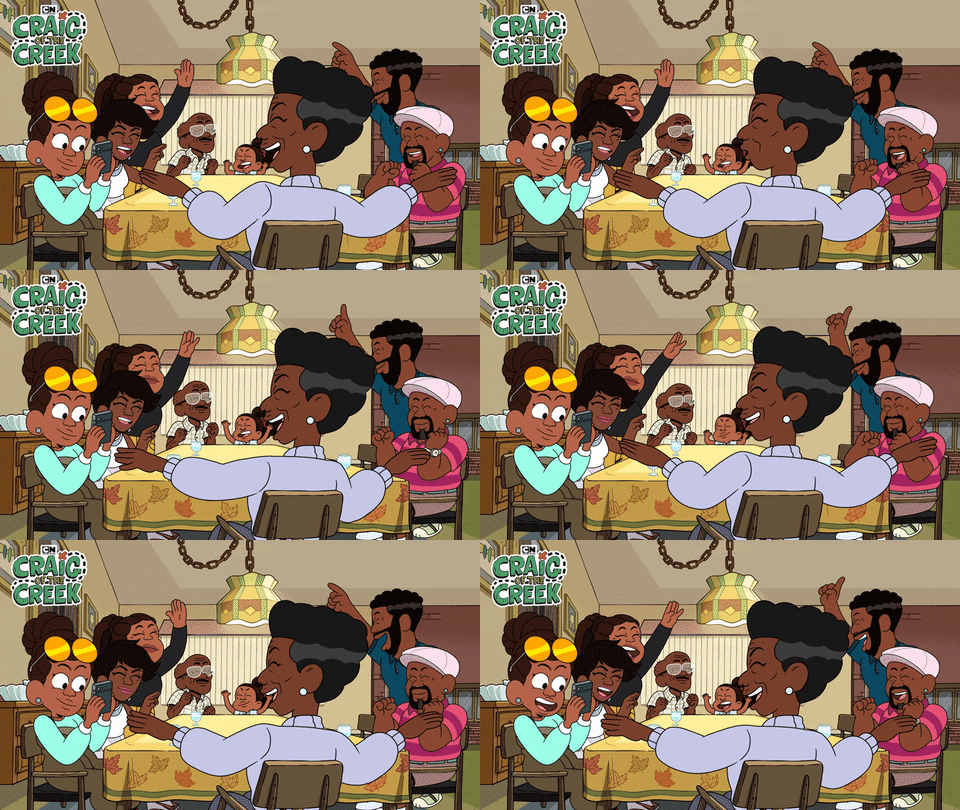
Craig's family at Thanksgiving (sans Craig, his cousin Bryson, and his older brother, Bernard)
There's also not a shortage of black kids in the Creek outside of Craig and his family. There's also Cannonball and Warp-speed from the 10-Speeds, Kit, and Sparkle Cadet, just to name a few. Not to mention, there are so many other examples of kids coming from other racial and ethnic backgrounds in the Creek, such as the Sewer Queen being Filipino and Raj from the Honey Suckle Rangers being Indian. Both of their cultures are explored in individual episodes where we get to know their families and backgrounds outside of the Creek.
The LGBT+ representation in this show is also incredible because Kelsey is canonically queer, along with a few other characters in the Creek, like the Creek Witches (two teen goth girls who trick the kids into thinking they're witches) and the Honeysuckle Rangers. There are also references to nonbinary characters- the merkid comes to mind- along with Angel, the Creek babysitter, who is also nonbinary.
In the fourth season of Craig of the Creek, the show introduced Jackie, who is a kid who is deaf/hard of hearing and introduced Craig to sign language. The fact that this show bothered to include something as real as sign language (specifically for a kid of color), was truly iconic behavior from the creators of the show. I don't believe I've seen disability representation like this since the animated The Little Mermaid series on the Disney Channel (or maybe Toph from Avatar: The Last Airbender).
Everyone should aspire to be this aware of other perspectives, and to take as much care as possible to represent them as well as Craig of the Creek did.
Category 4: Plot- C+
One thing about Craig of the Creek is that since this show is character-based and not plot-based, there isn't an overarching plot for most of the stories in this series.
Each episode of Craig of the Creek is more of less self-contained, so even if you start watching it in the middle of a season, you can follow along fine. Most of the storylines are about life in the Creek of Craig learning a lesson with his family of his friends. However, in the later seasons of the show, there are episodes that enhance the lore of the Creek, such as (SPOILER) the story arc with King Xavier and his impending invasion. The multi-episode story arc with King Xavier in seasons 2-3 was/is the most cohesive plot in the entire show, as most of the show's plots are one-offs or 1-2 episode arcs.
Most of the show just revolves around the main trio messing around and growing up. The stakes for most episodes are relatively low, but because the main characters are kids, everything seems like the biggest deal in the world. Everything from wearing a coat that makes you look uncool, to not wanting to try new foods, to wanting to beat your father at video games, all becomes life-or-death situations, despite how all of these issues are fairly common in everyday life.
The animation definitely reflects the severity of these issues to these kids, though.
Which leads into-
Category 5: Animation- A
Craig of the Creek was created by a lot of the same people who worked on Steven Universe (a show that I have never seen, nor do I have any interest in seeing due to the toxic fandom surrounding it), and from what I can tell, it includes a lot of the same themes of friendship and inclusion of people of color and LGBT+ representation. Matt Burnett and Ben Levin, the co-creators of Craig of the Creek, actually used to work with the storyboard artists for Steven Universe before Craig of the Creek was picked up by Cartoon Network.
Poster for Steven Universe (2013-2020)
Outside of Steven Universe, one of the things that I really appreciated when researching this post was that many of the storyboard artists for Craig of the Creek were people of color, specifically black people (some of whom also worked on Steven Universe as well). In fact, Pearl Low, one of the storyboard artists from the Oscar-winning short film, Hair Love, was a part of animating Sparkle Cadet in Craig of the Creek, which I think is amazing! (Watch the reel of her animation here- it's super interesting.)
The fact that this show hired more than one person of color to storyboard their show (Richie Pope, Lamar Abrams, Amish Kumar, and Tiffany Ford just to name a few) speaks volumes to the amount of care the team behind Craig of the Creek put into the show. Too often are animated spaces limited to white animators, further limiting the amount of access that people of color have in the world of animation.
I'm glad that this show not only depicts a person of color, but it also includes other people of color in the animation process, further cementing this show as one of my favorites.
Category 6: Kid-Friendliness- A+
This show was definitely 100% written for kids and with kids in mind. The amount of imagination involved with this show is incredible, and I can say without a doubt that this show is propaganda to get kids to play outside instead of play video games. If I were a child, I'm pretty sure it would work.
Sure, Craig and his friends have cell phones, but they rarely come up, as they spend most of their time playing and imagining fun worlds in the Creek. They run, they adventure, and they hang out with friends. This show is everything it meant to be a kid growing up, and yet it still manages to be so modern and new.
If kids aren't watching this show, they should start. This show is the best comfort cartoon that I've seen in recent years, because even though it doesn't have much of a cohesive plot (most of the time), the adventures the Stump Kids go on are fun and light-hearted. They learn lessons and conquer their fears, they adventure into worlds unknown, and live with imagination in their hearts.
I love this show.
Craig of the Creek is on the same level as another cartoon that I really enjoyed, Amphibia. I do believe I enjoyed this show a tad more, though, due to the fact that the characters are more relatable to me and my family, and it was so easy to binge several 40-episode seasons in a few weeks.
*As of October 2022, Craig of the Creek fell victim to the infamous (and truly heinous) HBO Max/ Discovery + merger, as Cartoon Network, the network that aired Craig of the Creek, has been effectively gutted by this move (see my previous post regarding HBO Max and animated content). Since then, the show's final season 5 order has been cut in half, along with its spinoff, Jessica's Big Little World's, first season being halved as well. There is a Twitter thread about this issue from Richie Pope, a storyboard artist for Craig of the Creek, linked here.
Along with other shows that have been impacted by this merger, such as Infinity Train or Close Enough (which is an adult animated series produced by HBO Max, not Cartoon Network, but stay with me), the merits of these shows are not what is preventing them from sticking around or not being cancelled by Cartoon Network or HBO Max. It is their profitability. Unfortunately, due to this awful corporate merger, there have been several casualties, and Craig of the Creek just happens to be the latest in this long, horrible list.
Overall, I love this show. It captures the magic and imagination around being a kid, and it allows for a broader audience to feel represented in its animation without feeling cheap or like it's pandering to certain people.Craig of the Creek is a perfect cartoon in my book (an A), and I hope that this show goes on to influence other animators to make shows that also inspire kids and adults alike to dream bigger and create more hopeful, inclusive content.
Thanks for reading!
This post was originally released last October as one of the final posts that I had for the early access tier of my Patreon. I want to say that I really appreciate anyone and everyone who read my blog posts on my now defunct Patreon, and everyone who reads them here, now. Thank you for your continued support.
Welcome! Thank you for joining us for Fight Night!
I've gathered you all here today to witness the fight of champions- the tournament of kings, if you will: Reboot-Mania! Four shows enter, only two will win!
Tonight, two reboots are facing off against their original shows in this nostalgia-battle: The Proud Family vs. The Proud Family: Louder and Prouder,
The Proud Family (2001-2005)
The Proud Family: Louder and Prouder (2022)
and iCarly vs. iCarly (2021):
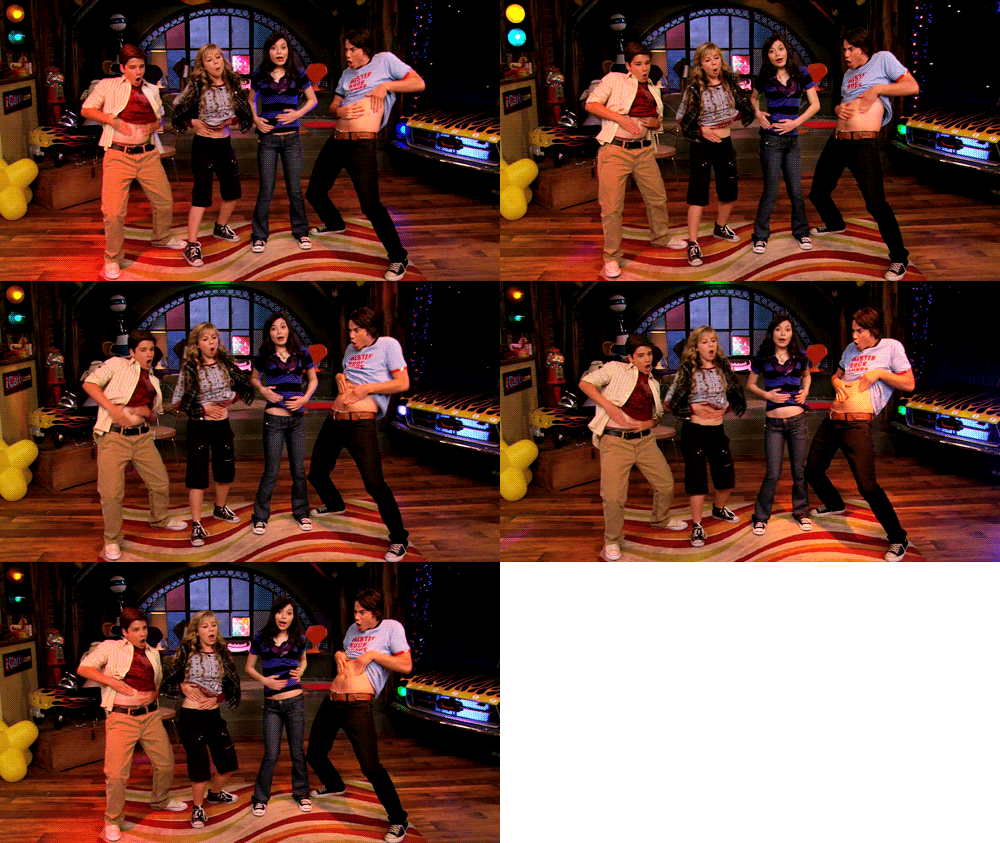
iCarly (2007-2012)
iCarly (2021-present)
After watching multiple episodes of both of these sitcoms and their reboots, I can confidently determine the winner of the ensuing smackdown. And so- LET'S GET READY TO RUMBLE!!
First round, The Proud Family and its reboot.
*Ding!* *Ding!*
The Proud Family is a black animated sitcom about a 14-year-old girl named Penny Proud and her family as they live in the suburban city owned by basketball tycoon, Wizard Kelly. Oscar Proud, her father, is the owner of an unsuccessful snack company called Proud Snacks, while his wife and Penny's mother, Trudy Proud, is a veterinarian. Oscar and Trudy also have twin babies, Bebe and Cece, and they all live together with Oscar's mother, known only as Suga Mama.
About a month ago, Disney announced the 20th anniversary of the original Proud Family series, along with their release of the new DVD box set of the entire 52-episode run. As a fan of the original- naturally- I ordered it and watched the entire first season over the course of two weeks.
And... let me tell you- I forgot how old The Proud Family was. Truthfully, I didn't realize how dated the show was until I started watching the first season, which initially premiered in 2001.
Do you know what else was popular in 2001? Parodies about The Matrix, and lessons about illegally downloading music from Napster (flashbacks to the piracy "You wouldn't download a car" meme come to mind). Not only did The Proud Family have both of those things (in the same episode might I add), but there were also dated cultural references to things like Destiny's Child and B2K, and many jokes/comments that wouldn't hold up in the year of our Lord 2022 (take literally anything Papi says about Suga Mama, for example).
HOWEVER, for the most part, the show still does a good job at scratching a cultural itch that hasn't been acknowledged before or since the show went off the air. Black animation kind of peaked with The Proud Family, and it's really easy to see why upon rewatch.
Something that I realized upon rewatching it was that I loved this show growing up because I could see myself in it. There were so many times when I could see myself in Penny, despite her hijinks. She was a smart, funny black girl with big ideas and (sometimes) a bigger head. I could also see elements of my family in Oscar and Trudy and Suga Mama. I could even relate to having annoying siblings like Bebe and Cece. Compared to other animated Disney Channel sitcoms at the time, The Proud Family was the most authentic version of a modern black family I had seen in a cartoon.
Sure, the characters were ghetto, cheap, trifling, and ashy, but they were also funny, smart, loving, and real.
This show meant a lot to me growing up, and upon rewatch, I still think it makes a lot of good points about family and standing up for what's right. Sure, Penny's friends were all terrible to her in the original series (which is something that was addressed to some modicum of success in a couple of episodes), but it could be argued that The Proud Family was trying to teach us about fake-friends, too.
Overall, I have to say that I love the original Proud Family. It is my second favorite black Disney Channel sitcom from the early 2000s (That's So Raven will forever have my heart). So, when I heard that they were making a reboot of the original show and bringing back the cast for the updated spin on The Proud Family, I was excited. I was just sure that I would love The Proud Family: Louder and Prouder just like I loved the original.
And... Well...
I'll just say this about The Proud Family: Louder and Prouder- they didn't false advertise. When I first started this show, my first reaction was that there was a lot happening in the first few seconds, and everyone on screen was screaming for no reason.
Straight off the bat, this show just feels... hollow? But not for the reasons that you may think.
My opinion of The Proud Family: Louder and Prouder is that it's trying too hard to make itself relevant. In the first couple of episodes, I was immediately put off because I found there were too many quips and rapid fire cultural references in the first three minutes, that all served to say "This ain't your mama's Proud Family. We know what the kids like today. They like Chloe & Halle, and smart phones, and drones, and they don't like things that aren't 'woke.'"
As an old fan, it's a little disconcerting. It's clear that The Proud Family is still a kid's cartoon, but it's been coopted by a new generation of kids, which is tripping me up a little bit.
There's something strange about growing up with The Proud Family seeing Penny beg her mom for a flip phone, only to see her again 20 years later with a smart phone and a full awareness of social media, all without having aged more than a year.
It feels like this show is a shadow of the former show, in which they're attempting to capture the magic from the original without understanding what made the original fun in the first place. For example, there's a lot of flanderization going on with the main cast. Everyone is amped up, playing into their worst or most known characteristics from the original show. Oscar is known for being cheap and trifling, and so he's cheap and trifling every episode. Suga Mama is notoriously mean and beats up Oscar all the time in the reboot, because that's something that happened in the original show. Bobby stays eating people out of house and home in the reboot, because that's what Bobby did in the original. And so on, and so on...
That’s not even to mention the inconsistencies with the original canon of the show. For example, in a recent episode of Louder and Prouder, Suga Mama’s real name is revealed to be Charlette, and it is discovered that her family is from Oklahoma. She is revealed to have three brothers and a misogynistic father, who she does not speak to. This is all well and good, only, this goes against some of the shows original canon, in which Suga Mama had a sister named Sista Spice who was a psychic that her parents adored for her special abilities. Louder and Prouder mostly ignores this lesser known episode in favor of this new idea for Suga Mama’s past, in which she was forced to face her misogynistic family and prove them wrong.
Despite my complaints, the show isn't all bad. There are changes and updates that I liked (The theme song isn't one of them.). For example, I like the fact that Michael from the original series is now included in Penny's crew instead of Sticky (since Disney has distanced themselves from Orlando Brown for obvious reasons). I also like that he is canonically queer, and that there are other examples of explicitly queer representation. I liked that they did an episode about LaCienega's Quinceanera, even though the episode itself kind of went off the rails.
The best episode of Louder and Prouder for me, though, was when the reboot went back to its weird roots and brought back everyone's favorite demon, Al Roker, for an episode where Penny wishes she was old enough to go to college. I liked this episode for a couple of reasons: 1. It seemed like a return to form in which we get to see Penny learn the consequences from her actions after being tricked by Al Roker (again), and 2. It seemed fun to explore what the show may have been if the creators had allowed Penny to grow up. Realistically, Penny should have been in her 30s by now, as she was a teen in the early 2000s. Getting a glimpse into what a college sitcom would have been like with these characters was fun, even if only for a 20-minute episode.
All that said, I can't help but feel like I wouldn't be so disappointed or annoyed by this reboot if there were more accessible black cartoons out there for kids. The only black cartoon I can think of that is still currently airing in 2022 is Craig of the CreekonCartoon Network, and I haven't had the chance to watch it yet. There aren't many other black cartoons for kids, period. A show like The Boondocks was not made for kids, and Static Shock went off nearly 20 years ago.
So really, what else are little black kids supposed to watch?
I know I've complained a lot about this reboot, but truthfully The Proud Family: Louder and Prouder isn't hurting anybody. It's just not for me.
Even though this reboot got picked up for a second season, it feels forgettable in a way. Something about it feels bland and generic, as it leans too far into its cartoon silliness for its points about social commentary to stick to anything. Unlike the original that felt like a cultural touchstone for early 2000s black kids, this show just feels like it's not really for anybody, because it's trying to appeal to everybody.
After watching both shows and comparing them, I can confidently say that I wish a new black animated show was greenlit by Disney instead of this unnecessary reboot. I would probably like it more.
So, if you ask me, I'll confidently declare that, "The Proud Family beats The Proud Family: Louder and Prouder in a clean knock-out!"
This round goes to the original series!
Round two: iCarly and its reboot.
*Ding!* *Ding!*
iCarly was a Nickelodeon sitcom about a teenaged girl named Carly Shay who lives in Seattle with her older brother, Spencer. After getting into trouble after school, she starts a comedy web-show (named iCarly) with her aggressive best friend Sam and her tech savvy neighbor, Freddie. Their web-show quickly becomes a viral sensation and launches the trio into internet stardom.
The original series is... quirky, to be sure. After recently binging the entire show from pilot to series finale, I have to say that this show has a vibe that feels very mid-2000s. Most of the comedy on the show is very silly and childish- but it works because the entire premise of iCarly as a web-show is centered around a couple of girls not taking themselves too seriously as they post funny videos on the internet. iCarly (the web-show) was born out of the character's desire to be as free as possible to express themselves and share that with others, which was very reminiscent of YouTube culture at the time that the show originally aired.
Speaking of internet culture, the original iCarly inadvertently predicted some of the biggest events that would hit the internet in later years. Episodes that come to mind are "iPromote Tech Foots" in which the iCarly gang accepts a sponsorship to promote a shoe brand that is less than safe (see the BetterHelp scandal for a real world parallel), and "iCarly Saves TV," where Carly and Sam are discovered on the internet by a TV executive, only to be given a TV show that deviated from the original content, and ultimately sucked (see A Little Late with Lilly Singh for a real world parallel). iCarly also had episodes featuring boxing matches with internet celebrities, being shipped by super-fans, being canceled for doing/saying something offensive or unpopular, and so on, and so on. This show was truly ahead of its time in the way it incorporated internet culture and was aware of the newer generation of kids who grew up using it.
I watched iCarly when it originally aired on Nickelodeon and I watched it all again recently, and for the most part, the show holds up. There are certain things that don't exactly sit right with me anymore, like Sam's abusive relationship with Freddie and the clear child abuse and neglect Sam receives from her mother, along with their frequent use of the word hobo throughout the show as if homeless people were caricatures- HOWEVER, the show is still a solid children's comedy.
For the most part, the show is lighthearted, silly, fun, and random. They even have a segment on their web-show called "Random Dancing!" iCarly encouraged a lot of kids to use the internet for fun, as iCarly.com was a real website where kids could watch videos of the original cast in exclusive online sketches, and play games with their friends (now going to iCarly.com will lead you to the Nickelodeon website where you can watch episodes from season 2 of the original series and a few other behind the scenes clips).
All in all, the original iCarly was about letting your inner weird kid out and having fun with your friends on the internet. So, when I heard last year that they were bringing the old show back for a more mature reboot of iCarly, I was cautiously optimistic.
And... (*Sigh*) Well...
Let me put it this way: the new iCarly is not a bad show.
It’s just... unfunny.
I'm not saying that to be controversial. I'm saying it because when I watched the eleven-episode first season of the iCarly reboot, I laughed a handful of times, and I liked a total of 2 episodes. The other episodes of this reboot are throwaway garbage.
Some of this can be attributed to the fact that the cast is out of practice. Miranda Cosgrove hasn’t really acted since the original iCarly ended back in 2012. She comes across as wooden and rusty in the first few episodes of the reboot, as Carly is explaining where she's been since we last saw her nearly 10 years ago. She gets better as the series goes on, but because she essentially has to carry the show without Jennette McCurdy, it is incredibly noticeable at first (I'll touch on that later).
Aside from the acting, the writing for the reboot just isn’t as strong as it was for the original. For one thing, the language of the show isn’t fun.
One thing that made the original iCarly special was its colorful language. Sam was especially known for making up phrases to sub in for popular curses (mostly to get around the Nickelodeon kid filters and FCC broadcasting rules about G television) however, they gave the show a sense of character that the reboot is lacking. Having Spencer and Carly be able to say “damn” and “hell” and “bitch” just isn’t as fun as calling someone a “wazzbag” or saying that something is jank. For example, the sentence, “that chiz is jank” makes no sense today, but it makes perfect sense in the world of the original iCarly. It may seem childish now, but so is the original iCarly.
(To the shows credit, they may be distancing themselves from that language as it was created by a very well-known and problematic producer/creator for the network who is no longer involved in the project. If that is the reason why they are not referencing old language from the original series, then I fully support this decision, even though I still believe it is ultimately to the show’s detriment)
The reboot lacks a lot of the iconic comedy that the original had in other ways, too. Most of this can be attributed to the fact that the writers are completely different, however, the show just lacks a certain silliness that the original show had. The new iCarly takes itself a little too seriously, and that's a problem for iCarly- the show that was born from its desire to let kids be weird online. Perhaps this show isn't as silly because adults can't be expected to act as wacky and irresponsibly as children do, but it's a little disappointing that most of the antics in this show arise from misunderstandings and not genuine wacky comedy. (The closest thing to wacky comedy the first season had to offer was "iRobot Wedding" where the gang goes to the wedding of their old rival, Neville. But to be honest, that episode was bad.)
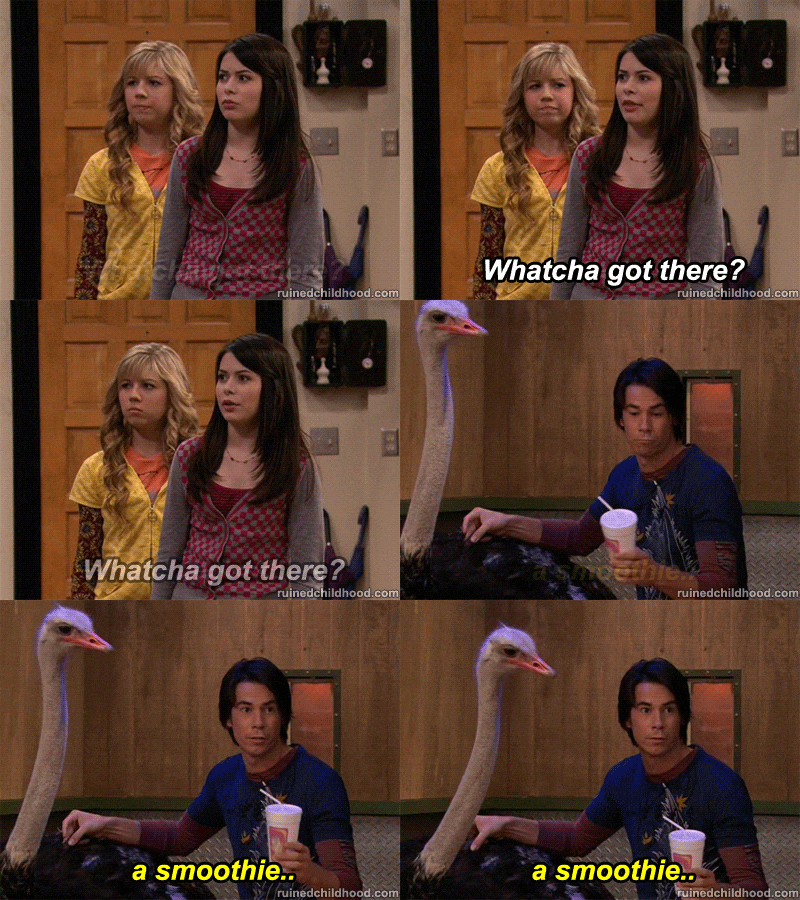
An example of the type of wacky comedy that the original show had that is lacking in the reboot.
Conceptually, the new iCarly is the same, but in feeling, the show is wildly different. For example, the new iCarly feels more like a standard sitcom with the caveat being that Carly has a web-show, instead of that being the entire premise. iCarly (2021) could have been any other millennial show where the main character works in social media instead of a show about the social media itself.
The original iCarly started or ended most episodes with clips from the web show, as it was integral to the plot of the show itself. The new iCarly only uses the web-show and the set pieces of the iCarly studio as an excuse for the show to exist, really.
A lot of the reboot focuses on Carly, Spencer, Freddie, and the new characters introduced for the reboot, Harper and Millicent. I mean no disrespect to the actors playing these new characters, because heaven knows they've received enough hate as it is, but I do not particularly enjoy either of these characters in this show. Not necessarily because of any performance-based reason, but just because of their characters’ personalities on the show, and how they fit into the overall tone of the new iCarly.
Firstly, Millicent plays Freddie's ex-stepdaughter from his second marriage (which is already much too complicated if you ask me), and she's a business minded and savvy young girl who happens to talk back a little too much for my liking. I found her annoying in most of the episodes that she was in, but overall, I could tolerate her, even though her relationship with Freddie made little to no sense (I think it would have been better and made more sense character-wise if Millicent was Spencer's daughter instead, but I digress).
Then there is Harper, a pansexual fashion stylist who works as a barista until her career takes off. She's currently Carly's new best friend since Sam left (presumably to star on Sam & Cat, but we'll touch on that later), and they live as roommates in Carly's old building. Harper is bubbly and sassy and a lot of fun to be around, but ultimately... I felt like she was in the wrong show.
Unlike Sam from the original, Harper has little to do with the iCarly web-show. I know that the writers and creators of the reboot didn't want to replace Sam because they didn't want to disrespect Jennette McCurdy or upset fans of the original show. But because of this, Harper feels extraneous to this show about a girl running a web-show. In fact, a lot of the reboot focuses on Carly, Freddie, and Harper's personal lives instead of the comedy of the web-show.
Again, this show seems more like a basic adult sitcom with "iCarly" branding on it, which feels like a shame, to be honest.
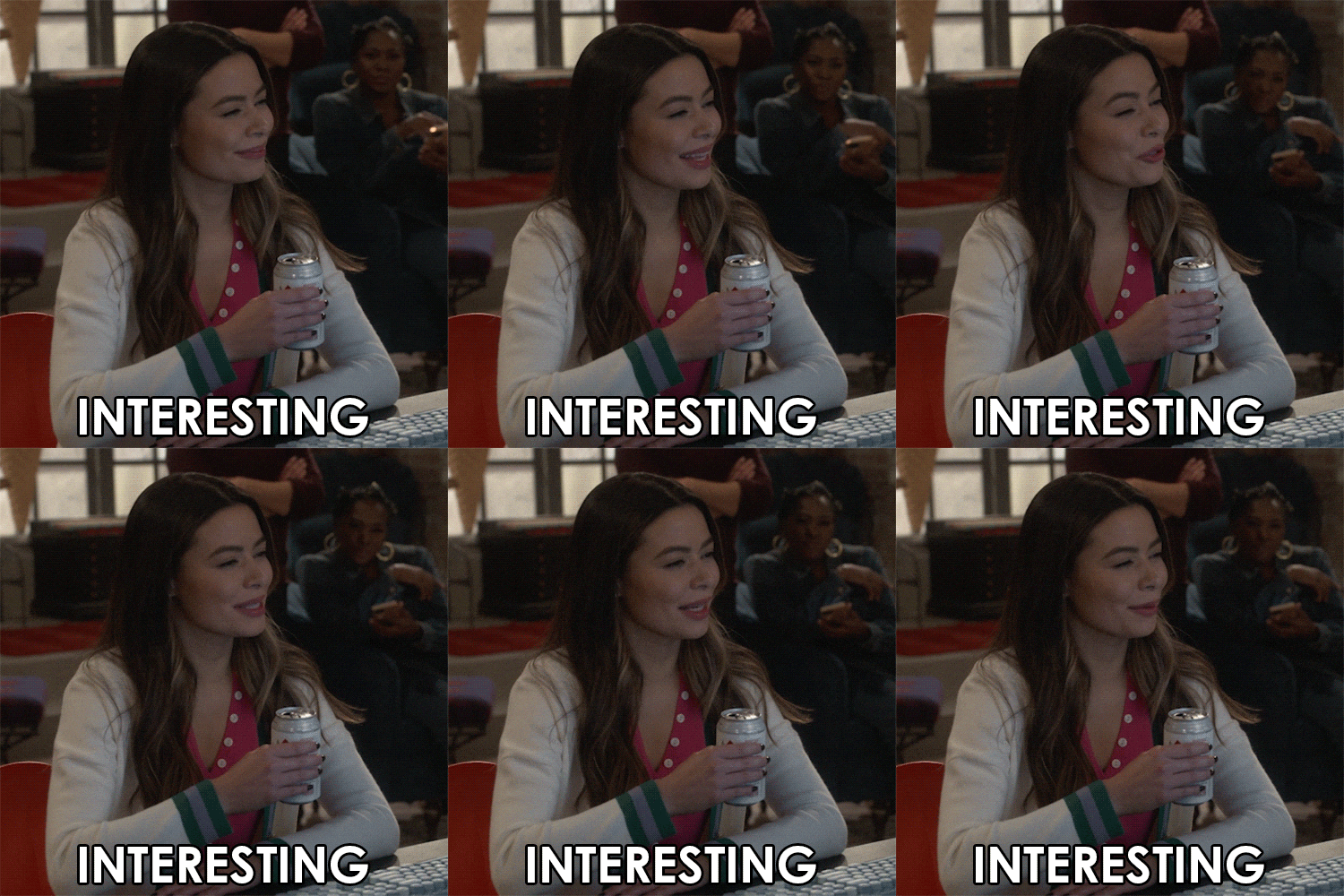
There are some bright spots in the series, such as "iFauxpologize" and "i'M Cursed" which I personally thought were the best episodes of the first season. These two episodes felt like a return to what I thought an iCarly reboot would be, in which the comedy is silly and lighthearted, and the references to internet culture are prescient and spot on. Since the reboot's second season just premiered, I'm hopeful that there will be more episodes like those down the line (although I'm not holding my breath). I also appreciated the fact that they aged up the characters to meet their original audience where they are at in their lives now, unlike The Proud Family reboot that rebranded so its demographic aged out of watching it. But mostly, I like that they made a reference to this old Miranda Cosgrove meme:
Miranda Cosgrove in Drake and Josh (2004-2007)
Miranda Cosgrove in iCarly (2021)
One thing that I touched on briefly before was how Jennette McCurdy decided not to not take part in the reboot as Sam Puckett, Carly's best friend from the initial iCarly. (Noah Munk, who played Gibby in the original series, also declined to return for the reboot.) Let's briefly discuss this:
In recent years, Jennette has been pretty outspoken about not liking the roles she was taking when she was younger and looking back on her acting career with a level of shame. This would notably include the role of the aggressive and often hungry, Sam Puckett, much to fans disappointment. After iCarly ended in 2012, Jennette went on to play Sam once more in the spinoff of iCarly and Victorious, Sam & Cat, which also starred Ariana Grande. Shortly after the show's abrupt cancellation in 2013, Jennette quit acting, and pursued other avenues in writing and directing instead. She has since refused to be a part of this iCarly reboot because of this pivot in her life and career.
Clearly the iCarly reboot has no desire to replace Sam as a character, and yet, while her absence is noticeable, it's not terribly distracting from the show. In fact, all things considered, the reboot probably works better without her character in it. That's not to say that I wouldn't love to see how Sam would react to situations in this series (because I definitely would), but all of the changes that the reboot made to the characters and the setup of the show wouldn't really work so well with Sam in the picture. It was comical when Sam was pranking and assaulting Freddie and others as a teen, but as an adult these actions have much different implications, and much more severe punishments than juvie.
Even without Sam, though, this show could be so much better.
In fact, in an ideal world, the new iCarly would be fun. In my proposed version, Carly would stop doing beauty tips on her web-show and start producing an offbeat SNL type sketch comedy show that took her back to her comedy roots. Spencer could help her by making art pieces and backgrounds and Millicent and Freddie could help with the business and technical side of things, respectively. Since Harper likes styling people, she could be the wardrobe stylist for all of the sketches. I feel like this reboot had all of the necessary pieces to be fun and enjoyable to watch, but it just... isn't. The show itself is bland and unremarkable, in a way that is sad to watch.
Again, like The Proud Family Louder and Prouder, the iCarly reboot isn't hurting anyone. It just... isn't very good. I wouldn't recommend watching it, but if it brings joy to some other fans of the original, who am I to say that it's bad? I hope some people love watching it so that Jerry Trainor can stay employed for a little longer.
In the end, though, it's safe to say that while iCarly (2021) was swinging with all of its might, it just couldn't seem to score enough points to beat the original.
"And... The original iCarly takes it in a knockout!"
It looks like a clean sweep for the original shows, Ladies and Gentlemen. Who could've guessed?! The blowout of the century!
In all seriousness, I think I may just be tired of nostalgia culture.
Everywhere I look there are reboots and rebrands and spinoffs and sequels. Nowadays almost every popular IP has to have its own extended universe or new spin that makes it relevant to the kids of today. Without thinking too hard, I can name a handful of other iconic TV shows that have been rebooted recently, even within my lifetime (How I Met Your Mother v. How I Met Your Father immediately comes to mind- although that may be a spinoff instead of a reboot). And at the risk of sounding old and out of touch, I just don't get it.
I once loved The Proud Family and iCarly, but these reboots don't seem to capture the spirit of the originals. Not only were these shows groundbreaking during the time they originally aired, but they were incredibly influential to an entire generation of people like me. Somehow these reboots feel like a desperate cash grab or ploy to shift our attention to Disney+ and Paramount+ for the time being. It's clear that reboots have taken over the streaming war, and I would rather not participate in this war of attrition.
I think enough is enough.
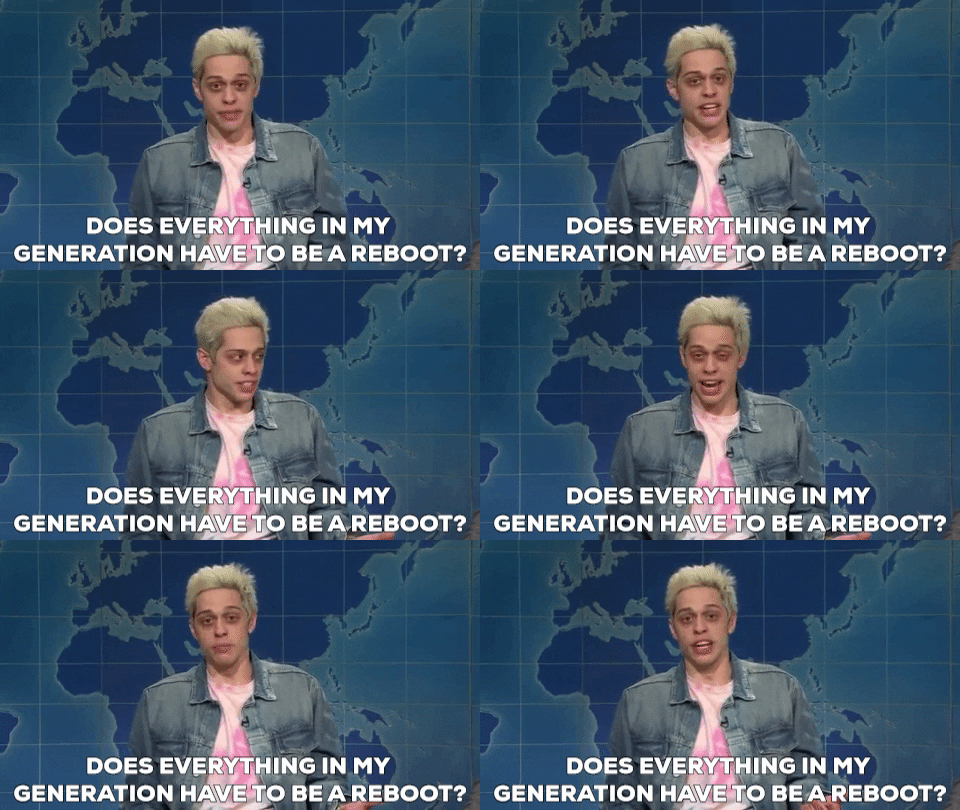
Maybe Kim Kardashian's ex-boyfriend, Pete Davidson, had a point:
No, Pete Davidson. No, it doesn't.
Thank you for reading everyone.
If you liked this post, then be sure to subscribe to my Patreon, where you can get posts like this one up to three months earlier than they release on this site. This post was originally released to patrons in April of this year, so if you want to stay up to date, then click the banner above to follow me on Patreon. If you don't want to support me monthly, then consider making a one-time donation on Ko-Fi using the button below.
I hope you all are having a great day. Stay safe out there, and take care of each other.
So, unless you’ve been living under a rock recently, I’m sure you’ve heard all about the new Disney/Pixar movie that is sweeping the internet, Turning Red.
Like Encanto that came before it, Turning Red has turned Twitter and Instagram into a haven for people who create fan art and post fan theories about this movie. Since the film premiered on Disney+ on March 11th, I have seen more than my fair share of think-pieces surrounding what Turning Red means to people, and the reception around it.
Well- if only to feel included- I thought I would give you my take on the movie.
And my verdict was…
I loved it. I think Turning Red was pretty great, actually. It wasn’t perfect, but it was definitely a good movie. Dare I say, I even liked it better than Encanto.
My feelings about this movie are complicated, which is why I felt the need to break them down. I have to explain why this movie is undeserving of its outrageously low Rotten Tomatoes score and the wave of backlash that it’s gotten from some critics.
Rotten Tomatoes score for Turning Red (2022)
Rotten Tomatoes score for Soul (2020)
Currently (as of March 2022) Turning Red has a 72% fresh score on Rotten Tomatoes, which is noticeably less than some of its other Pixar counterparts, like Soul, for example. (Which, I mean, come on. *rolls eyes*)
I find this unacceptable (and not just because I didn’t like Soul). Because of this, I think it’s about time we dive into Turning Red to see what all the fuss is about.
Let’s start with the basics:
Category 1: Plot- B
To start, Turning Red is about a Chinese Canadian thirteen-year-old girl named Meilin "Mei" Lee. She is essentially her mother’s pride and joy: she excels in school and participates in her family’s Chinese temple when she’s home. Most of all, she always listens and respects her mother.
Only… Meilin is growing up, which complicates things.
The real Meilin likes hanging out with her friends and obsessing about boybands and crushing on boys. That doesn’t mean that she doesn’t love her mother, it just means that she may not be the person that her mother wanted her to be.
To further complicate things, Meilin has hit puberty, which means that she transforms into a giant red panda when she’s emotional.
Literally.
Now, I can’t help but point out the obvious panda in the room. This movie, like many other Disney movies before it, features a main character of color turning into an animal for a large portion of the movie in order to learn a lesson. Although, unlike some other films that have done this (*cough, cough* Soul), Turning Red uses Mei’s transformation as more than just a plot device. In this movie, her transformation into a red panda also serves as a metaphor for growing up (which I’ll touch on later).
Also, unlike other animated movies of this type (because as I’ve stated before, there is a list of movies where POC are turned into animals in cinema), Turning Red treats Mei’s transformation like a cultural touchstone that makes sense in-universe. Turning into a red panda has been passed down through her mother’s family for generations. There is no arbitrary magic spell or potion that turns the characters into animals like in The Princess and the Frog, or The Emperor’s New Groove, which was a nice change of pace.
Overall, the plot itself is about Meilin growing up, and trying to find herself when faced with the rising awkwardness of puberty.
Which leads me into my next category-
Category 2: Themes- B
This movie explores all of the awkward moments associated with growing up, but chief among them is the theme that you can choose to be who you really are when you're going through puberty. Throughout this movie, Meilin is torn between being the person that her mother wants her to be and being the person that she really is around her friends at school. Turning into the red panda complicates this even further, as her mother attempts to help Meilin control this part of her, while her friends are more supportive of it, encouraging her to embrace her transformation. This inevitably leads to Meilin coming out of her shell and learning who she truly is as a person outside of her mom's shadow.
This movie also explores the lesson that embracing your quirks is nothing be ashamed of. For example, there is a really beautiful moment early into the movie where Meilin’s mom catches her drawing a boy that she has a crush on. This leads to Meilin experiencing immense shame and scolding herself for being “weird,” or “awkward” for doing so. I loved that part of the movie because it was delightfully real, and also telling of how sometimes we tell ourselves that we're not allowed to be as weird or awkward as we actually are. By the end of the film, Meilin comes to fully come to accept herself, and learns that it's normal to be awkward at her age. Truly, there's nothing wrong with it.
In addition to all of this, there are also themes surrounding Mei’s transformation into the red panda. Outside of the obvious metaphor of Mei “changing” being a stand-in for “growing up,” the red panda can be seen as a metaphor for having your period and developing as a young woman. If you interpret the title this way, then “turning red” is a clever double-entendre for the beginnings of quote-unquote “womanhood.”
Overall, the themes of this movie are not very subtle, and yet they're very universal (despite anyone who would argue the contrary), which is one of the reasons why I think this movie is so good.
Category 3: Characters- B+
This movie is very interesting to me, because like Encanto that came before it, all of the characters in this movie have developed a cult following on Twitter and TikTok, despite the fact that most of the characters are secondary to the actual plot of the film.
In Encanto, a movie about a magical family living in an enchanted house, this was seen in the cosplays and fan art of fan-favorite characters, Dolores and Camilo.
Dolores and Camilo (brother and sister) from Encanto
In this movie, the fan community has come to really rally behind Meilin's friends: Miriam, Abby, and Priya. I have seen so many Twitter posts about the love that these girls have for each other and for Meilin as she goes through her transformation. Specifically, people online really love Miriam and Priya for their perceived role in the LGBTQ+ community (which I will touch on later).
Miriam, Abby, and Priya (from left to right)
Me, personally, I love Meilin's friends. I love that they're supportive of her when she is going through her struggles with her family, and they are nerdy and dorky in the same way that me and my friends were at that age. They don't pretend to be cool, and they lean into the awkward parts of themselves- like the fact that their favorite band is 4*Town. They look and act like awkward teens, and I’m here for every second of it. I get why fandom culture has adopted them as one of their own.
#squadgoals, honestly.
Another strong character in this movie that I feel doesn't get enough love is Mei's mom, Ming. Ming is honestly one of the most compelling mother figures that I have ever seen in a Disney movie (and yes, I am including Mother Gothel from Tangled). She's complex in a way that never makes you feel like she doesn't love and care for Ming, and she's realized in a way that makes me feel empathy for everything that she's going through. It’s very clear that she is not the villain of this movie, even though she is one of Mei's main antagonists.
Ming also struggles with Mei’s transformation, as she tries to understand that her daughter is coming into her own. She’s a little controlling, but she means well, and that’s what makes her realistic to me. I feel like I’ve definitely met people like Ming.
Personally, I love Ming so much, and I think more people should be talking about her. However, I would be remiss if I didn’t at least mention my absolute favorite character in the movie, Mei’s dad, Jin. Jin is the epitome of a supportive father figure, and we love that for him. He’s quiet and encouraging of Mei and supportive of his wife, all while cooking the most delicious food…
Overall, all of the characters in this movie felt real in a way that made this movie better. I could see my friends in Mei’s friends, and I could understand where Ming was coming from when she was attempting to help Mei out.
Strangely, out of all the characters in this movie, I feel like I have the least to say about Mei. As the protagonist of the film, she was relatable in her journey of self-discovery, and her awkward puberty experiences were traumatizing for someone who also experienced puberty, but beside the other characters in this movie, she can seem a little flat, unfortunately.
That said, though, no one in this movie was one-dimensional, which was great to see. All of the characters shined through in some way or another.
Category 4: Animation- A
It's pretty much a given at this point that the animation in this movie is going to be impeccable. In fact, Disney & Pixar is known for its fantastic animation in all of their movies, but something about the animation in Turning Red feels... different.
Most of this can be attributed to this movie's very clear anime influences. Since this movie takes place in the early 90s, there are several nods to popular anime like Pokemon and Sailor Moon throughout this movie. This is clever because these shows were incredibly popular at the time that the movie was set, while also expressing Mei's Asian background visually. This can be seen in everything to very clear setting parallels, to the over-exaggerated anime eyes that Mei and her friends get when they're listening to their favorite boy band.
Panda Mei and her friends sitting in front of a Sailor Moon inspired Toronto.
To top it off, there is also an iconic scene where Mei's dad is cooking dinner, and all of the food looks amazing, like it came straight out of a Studio Ghibli movie. It is clear that the creator of this movie, Domee Shi, wanted to pull from as many anime sources as she could to give this Pixar movie its own unique style.
If you ask me, she succeeded, because I've definitely never seen anything like it, and I felt like this new animation style really injected some life into the standard Pixar animation style. This film really shines, and the animation really makes this movie that much more memorable.
Category 5: Diversity- C
One of the things that immediately stand out about this movie is that it's about a Chinese Canadian girl, which is a demographic that is not well represented in mainstream animated films, let alone films produced by Pixar.
This is not only insulting to the demographic that this film actively represents, but it is also incredibly telling of the stories that people are used to getting in movies, animated or otherwise. Asian girls are not usually depicted in such a humanizing way, especially not in animated children's movies. That said, most movie reviewers who post their opinions of films on the internet are white men. The fact that multiple reviewers have claimed that Turning Red is unrelatable to them due to the demographic is indicative of the fact that they're used to white stories.
As a black woman, I can't tell you how many movies that I've sat through that centered a white man doing something that I would never have done in a million years. And yet, I wouldn't call any of those movies unrelatable because most of the time, the stories displayed in those films are meant to show you a window into something deeper than the characters themselves.
The fact that this movie centers an Asian girl going through puberty has everyone up in arms, and it makes me sad, because it proves that we have a long way to go in terms of representation in media, especially in children's media.
Speaking of having a long way to go in children's media, while this movie does feature prominent Asian representation in the main cast, there is another minority group that is definitely lacking in representation in this movie: the queer community.
This brings us back to Priya, Mei's Indian Canadian friend who was often depicted as a wannabe goth girl. Throughout the movie, Priya is seen holding Twilight inspired vampire novels, and obsessing with her friends about their favorite boyband, 4*Town. However, about midway through the film, it is revealed that perhaps Priya may have a crush on an actual goth girl when they meet at a party and begin dancing together very closely.
Priya dancing with her goth girlfriend.
Priya's feelings are never stated explicitly and remain subtext in the movie, however, it is definitely some sort of indication that Priya was meant to be coded as something other than straight. This has led to fans believing that Priya could be bisexual and interested in both boys and girls.
This bisexual theory has also been applied to Miriam and Mei, as some of their scenes together are slightly queer coded and intimate, even though the two are best friends. Once more, there is never an overt queer love story between the two, and anything that may be perceived as queer is only subtext.
Perhaps the most telling of this incident is the character Tyler, who bullies Mei and her friends up until the third act of the movie, when the girls discover that he likes 4*Town, too. Apparently, Tyler had a storyline in the movie that had to be cut out of the final version of the film. It was never revealed what this storyline entailed, but many fans have speculated that Tyler was secretly gay and that's why his storyline had to be reduced.
Overall, it is disappointing that Disney likely cut any or all storylines regarding overt queer characters due to their support of the "Don't Say Gay" Bill. I know that a lot of people were and continue to be hurt by this, and I just wish that Disney would stand by the people that just want to love the people they love.
While this movie shines in its Asian representation, Disney does not get a pass on its poor treatment of the LGBTQ+ community.
Category 6: Kid Friendliness -B+
Here's the thing about this movie: it's controversial.
But honestly... it really shouldn't be.
The people that believe that this movie isn't appropriate for kids are fooling themselves into thinking that teenaged girls are much purer than they actually are. These people are often misguided parents or puritanical adults who believe that young women should be chaste and obedient, no matter the personal and social cost. It's the same mentality that pretends that teenagers shouldn't have access to decent sex education classes, and the same mentality that ignores the growing number of teenaged girls who are experiencing depression and suicidal thoughts.
These people are not paying attention.
Teenaged girls are people too, and frankly, Turning Red just treats them like they are. Instead of presenting them in the standard kid's movie teen-girl archetypes of "boy crazy," or "nerd," Turning Red allows the girls in this movie to be weird and earnest and awkward. More to the point, there are never any inappropriate mentions of sex or adult themes in the film that would make this movie inappropriate for children. The closest that this movie comes to discussing anything remotely related to sex (and I can't stress enough that this is unrelated) is the mention of Meilin getting her period.
After watching Turning Red, it becomes very clear that this controversy is not about the movie at all, but it's about how much society hates teenaged girls. (Especially when they look like teenaged girls.)
As proof, here's a review that I found on Rotten Tomatoes without even having to look that hard:
This movie is focused on the issues surrounding a teenaged girl becoming a woman and developing through puberty. This is the sticking point for most critics that claim that this movie is inappropriate for children. I would argue that the people who think that blatantly believe that women’s issues shouldn’t be commonly discussed in any capacity, let alone children's media.
This movie is made with the intent for teen girls to normalize their changing bodies. That makes some critics uncomfortable. However, their discomfort at seeing this is due to the misogyny that is rampant in our culture.
(A Turning Red hot take from a "misguided parent or puritanical adult")
The implication above is very clear: Somehow this Pixar film featuring a main female-teenaged protagonist cannot be a "family favorite" along the lines of Ratatouille or Cars (presumably because the author relates to rats and motorized vehicles more than Chinese Canadian teens, but what can I say). The author of the post criticizes the very notion that teenaged girls can't "find themselves," and should listen to their parents, as if this would make a better movie (as if Nemo from Finding Nemo didn't literally swim into open ocean to get away from his smothering father). And- once more- the edgiest, most progressive thing about this movie is that it mentions periods and shows what a pad looks like. If we're going by that standard, every Always commercial has been promoting progressive adult themes since the mid 20th century.
It’s the Twilight problem again, in which people are forced to confront the fact that the thing they don’t like is widely hated just because teenaged girls like it or see themselves in it. As soon as teenaged girls stop liking it, it becomes more socially acceptable to enjoy the media that was so popular many years ago (take the Twilight Renaissance, for example). This can impact both women and men, and it runs deep in our society.
To put it simply, our society hates teenaged girls. (That is to say, despite teenaged girls being the biggest driver of economic trends) We can appeal to them only so much before we start making fun of the things they enjoy or the things they think, because ultimately our culture cares more about the ideas of middle-aged men than a new generation of women.
Rachel Shukert, the showrunner of the recently canceled Netflix show, The Baby-Sitter’s Club, essentially confirmed this in her Variety exit-interview:
Shukert’s whole interview was incredibly interesting, and several good points were made throughout about children’s media for young girls. I highly recommend reading the whole thing.
I still argue that Turning Red is an important movie for everyone to watch, not just teenaged girls. I think if more people watched it and learned about the difficulties associated with growing up as a teenaged girl, they would have more empathy for them, even if they don’t (quote-unquote) “relate.”
You don’t have to menstruate to relate, everybody. We’ve all been teenagers before. Adolescence is awkward no matter if you’re a boy, a girl, or a nonbinary teenager. Middle school was rough for all of us.
Growing up can be awkward and terrible and really embarrassing, but Turning Red explores this in a way that is both kid and preteen friendly.
Hell, I’m an adult and this movie made me cry.
I really had a good time with Turning Red, and as someone who watches a lot of kid’s movies, I would say that this movie is definitely appropriate for people of all ages.
Overall, I really liked this movie. I laughed, I cried, I thought about all of the insane crushes I had when I was thirteen…
Even though I wasn’t a teenager in the early 2000s, Mei and her friends felt real in a way that was so close to home. I really liked this film and how it represented growth and maturity, without forcing anyone to grow up too fast or completely turn their back on their true identity.
I enjoyed Turning Red. If nothing else, I was thoroughly amazed at how this movie accurately captured how it felt to be an awkward teenager. Because of that, I would give this movie a B+.
Thank you for reading everyone!
If you liked this post, then be sure to subscribe to my Patreon, where you can get posts like this one up to three months earlier than they release on this site. This post was originally released to patrons in March of this year, so if you want to stay up to date, then click the banner above to follow me on Patreon. If you don't want to support me monthly, then consider making a one-time donation on Ko-Fi using the button below.
Have a great day, everyone. Take care of each other.